
This post may contain affiliate links. View the disclosure for more information.
Okavango Delta lions are at the top of the list for every safari traveller visiting the Okavango Delta. These African predators are called kings of the jungle for a good reason, and there is an abundance of them in the Okavango Delta.
In this article, I share everything safari travellers need to know about these mighty hunters.
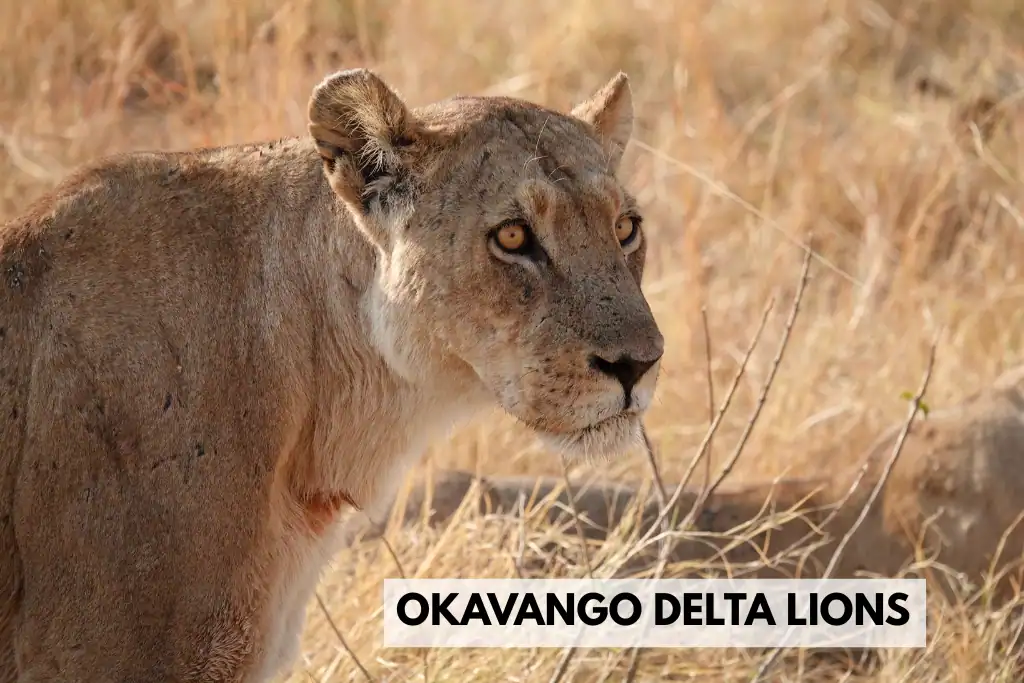
Visiting Botswana for a safari of a lifetime to see Okavango Delta lions is a dream. That is two big adventures at the same time, the Okavango Delta and lions!
However, if you are anything like me, you are probably conducting as much research as possible on what to expect and how to prepare to see well-loved animals.
In this article, I share everything about Okavango Delta lions, Okavango Delta lions size, Okavango Delta lions facts, tips on the best time to visit and more.
After learning about Okavango Delta lions, you will have the knowledge and skills you need to travel Botswana like a pro.
This post is all about Okavango Delta lions.
Okavango Delta Lions Facts
Okavango Delta Lions size
Built for dominance and survival, Okavango Delta lions are enormous, larger than the lions found in the savanna or elsewhere in Africa, thanks to the abundance of water and animals to prey on.
Okavango Delta lions weight is astonishing. Male lions weigh around 230 kg(507 lbs) and can stretch up to 2.5 metres(8 feet) from nose to tail.
Female lions are lighter, more powerful, sleek, and fast; they weigh around 160kg (352). However, do not be mistaken by their size; they are powerful hunters, often leading the hunt.
Now, let’s talk about Okavango Delta lions muscle, because that’s the first thing you’ll notice if you see these big cats for the first time. An adult male lion carries up to 60% muscle mass.
How come they are this muscular? Genetics, of course! And constant physical activity combined with plenty of food available in the Okavango Delta.
Okavango Delta lions size comparison
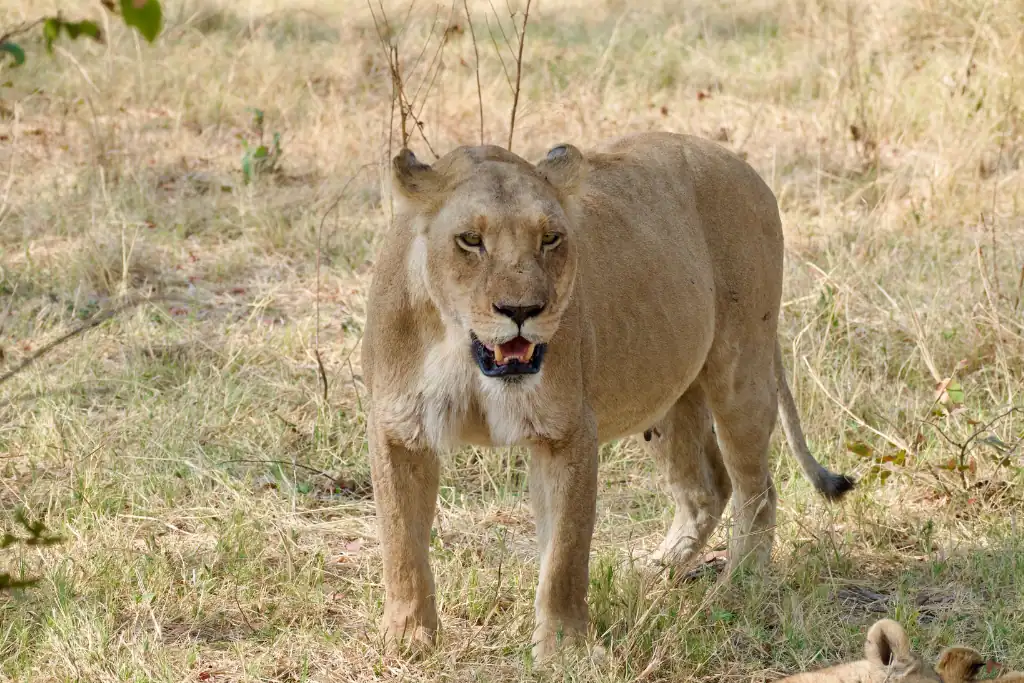
Some people call the delta lions “super lions” because they are larger than lions found anywhere else in the world. Moreover, they are even bigger than the lions found in the Kalahari Desert in Botswana.
Male Okavango Delta lions can weigh up to 250 kg, whereas Kalahari lions can weigh up to 214 kg.
Female Okavango Delta lions can weigh up to 180 kg, whereas Kalahari desert lions can weigh up to 150 kg.
And it all comes down to adaptation. The environment in the Delta is entirely different from that in the Kalahari Desert, located in the same country, but with a distinct biome; both animals must adapt to their environment.
Although extinct, the Barbary lion is considered larger than the Okavango Delta lion. The recorded weight of the male Barbary lion ranges from 270 kg to 300 kg, which is huge given the lion’s muscular build.
Botswana Lion Population
Botswana has a healthy lion population of around 3,000, which is thought to be increasing, making it the largest in Africa. This means you have a great chance of spotting lions on your safari, especially in the Okavango Delta.
This number includes lions in the Okavango, Chobe, and Moremi, where predator concentrations are high.
This thriving population can be attributed to Botswana’s strong conservation efforts and strict anti-poaching laws, which are effective, given that most of these areas are unfenced.
Okavango lions unique characteristic
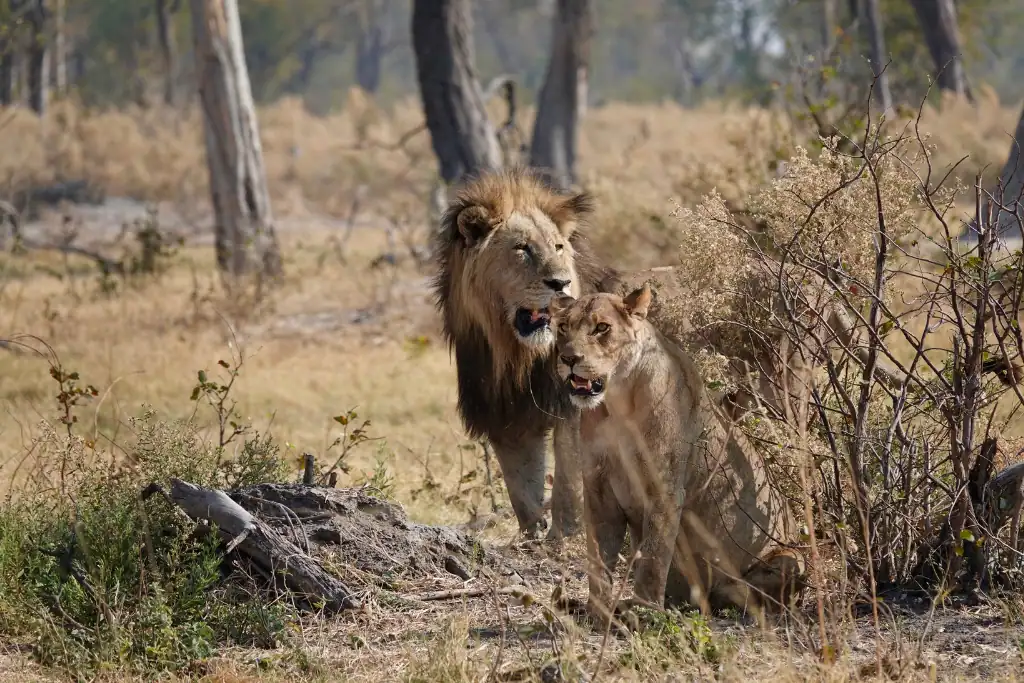
Aside from their size, these African predators have mastered the art of adaptation. Would you think a lion would swim? Well, they do in the Okavango Delta, and they are good at it.
Surrounded by wetlands and floodplains, they must sometimes swim to catch their prey or move from one place to another.
Another astonishing characteristic of the delta lions is that they are daytime hunters, unlike Kalahari lions and other African predators, which are nocturnal.
Moreover, Okavango Delta lions are more daring when it comes to hunting; they do not typically go after the most common prey in Botswana, such as impalas or lechwe.
They hunt other dangerous African predators, such as buffalo, which provides a sufficient meal for their size, and in turn, answers the question ‘why are Okavango delta lions so big?’
Additionally, the Delta Lions have adapted their hunting style; instead of relying on their stamina and power, they have evolved to work as a team.
They join “paws’, so to speak, and ambush their prey. And I must add that they are successful and thriving in their environment as a result.
I have witnessed this frequently while staying in Sable Alley in the Okavango Delta. Lions work as a team; they travel together and feed together.
If you see one lion, please be aware that there is a high chance others are nearby. It was here that I witnessed the biggest lion pride I have ever seen.
Another interesting characteristic is the appearance of their manes; they are lighter and less dense than those of the Kalahari lions. This is another adaptation to the humidity and heat of the Okavango Delta.
Okavango Delta lions vs Tigers
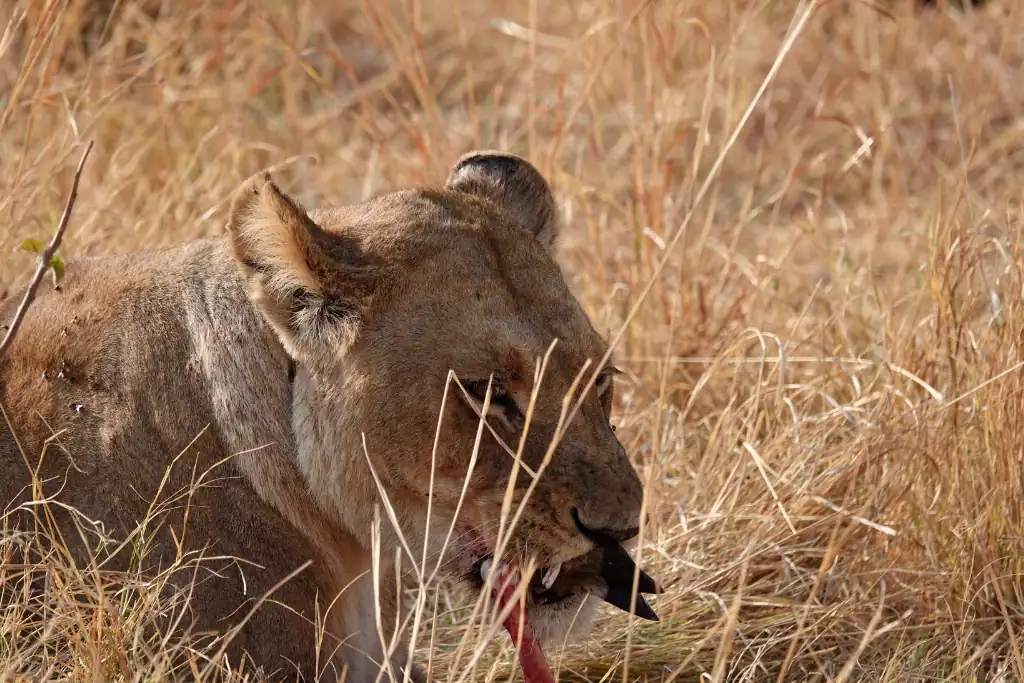
In general, tigers are stronger, bigger, and better hunters than lions. However, the Okavango Delta lions have exceptional characteristics: they are bigger, stronger, more muscular and more powerful than the normal lion.
However, I am not aware of any real-world head-to-head comparison between these two intimidating predators. Furthermore, there are no tigers in Botswana. So, we don’t know who will win a fight between a tiger and an Okavango Delta lion. I’ll leave it to your imagination!
Best time to visit
The best time to visit the Okavango Delta to see the delta lions is during the dry season (May to September).
This is by far the best because, first, the water levels are low, and these mighty predators come to water holes to drink; spotting them is therefore easier.
Additionally, prey gathers near the water holes, giving you a chance to see these predators in action.
Also, during the dry season, the weather is cooler; therefore, there will be increased activity in the wilderness, and lions hunt more often when it’s cool.
This allows you to spot them in action, which is both scary and thrilling.
Furthermore, the roads are not muddy, so there is better access and opportunity to follow the pride if you spot them, and we did a lot of that in September.
Where in the Okavango Delta can I find lions ?
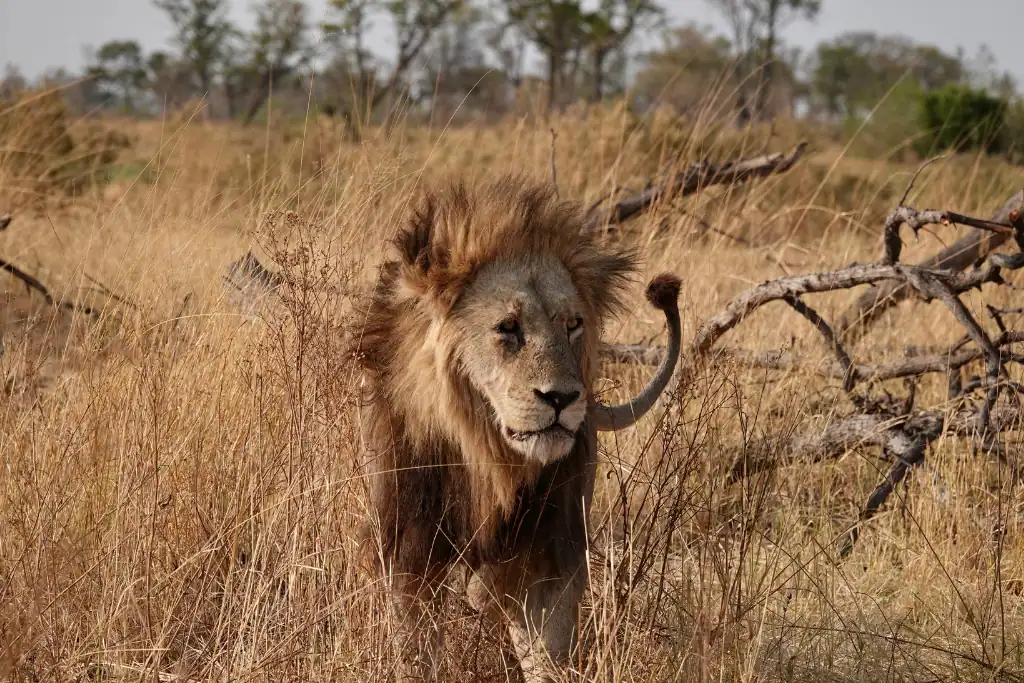
The Okavango Delta is a paradise for lions. As long as you are in the Okavango Delta, you will be able to spot them, given that you visit at the right season.
Whether you are self-driving in the Okavango Delta or staying at a permanent lodge, there is a high chance that you will see Okavango lions.
To simplify things for yourself, I highly recommend booking a tailor-made Okavango Delta safari package.
If you are on a luxury safari, there are bespoke luxury safari packages that you can choose from, and they are completely customisable.
Furthermore, there is a high concentration of predators, including lions, in Moremi Game Reserve and Private Concession. Consider booking a lodge in these areas.
If you are on a camping safari, these areas have excellent camps. Moremi and Khwai community areas seem to be famous with safari campers.
I personally stayed at Sable Alley and Tuludi camp, adjacent to Moremi Game Reserve. They were the absolute best choices.
How do I get there
You can reach the Okavango Delta by air or by road. If you are an international traveller, first you need to reach Maun, preferably, as it is closer to the Delta. If you are in the country, you can travel fairly easily from Gaborone to Maun.
However, travelling from Gaborone to the Okavango Delta requires a bit more effort because you cannot directly fly from Gaborone to the Delta.
Once you are in Maun, you can take a charter flight, self-drive, or book a tour company to drive you around the delta.
What I have observed is that most guests travel to Maun from their respective countries and use a local tour company to drop them off at their lodge or camp in the Okavango Delta, as it is much more affordable and hassle-free.
Critical Botswana safari safety tips
As you will be in the presence of one of the most dangerous African predators, we must discuss safety measures. A few smart precautions, combined with common sense, go a long way in keeping you safe and the wildlife undisturbed.
1. Stay in the vehicle
Not to sound like a broken record, because I’m sure I have discussed this somewhere, but STAY IN THE VEHICLE. Never get out of the car or let your legs and arms dangle out of the vehicle.
2. Listen to your guide
Your guide understands these animals’ behaviour better than we do as guests. They know and can sense animal tension and frustration before we even realise there is something not going right.
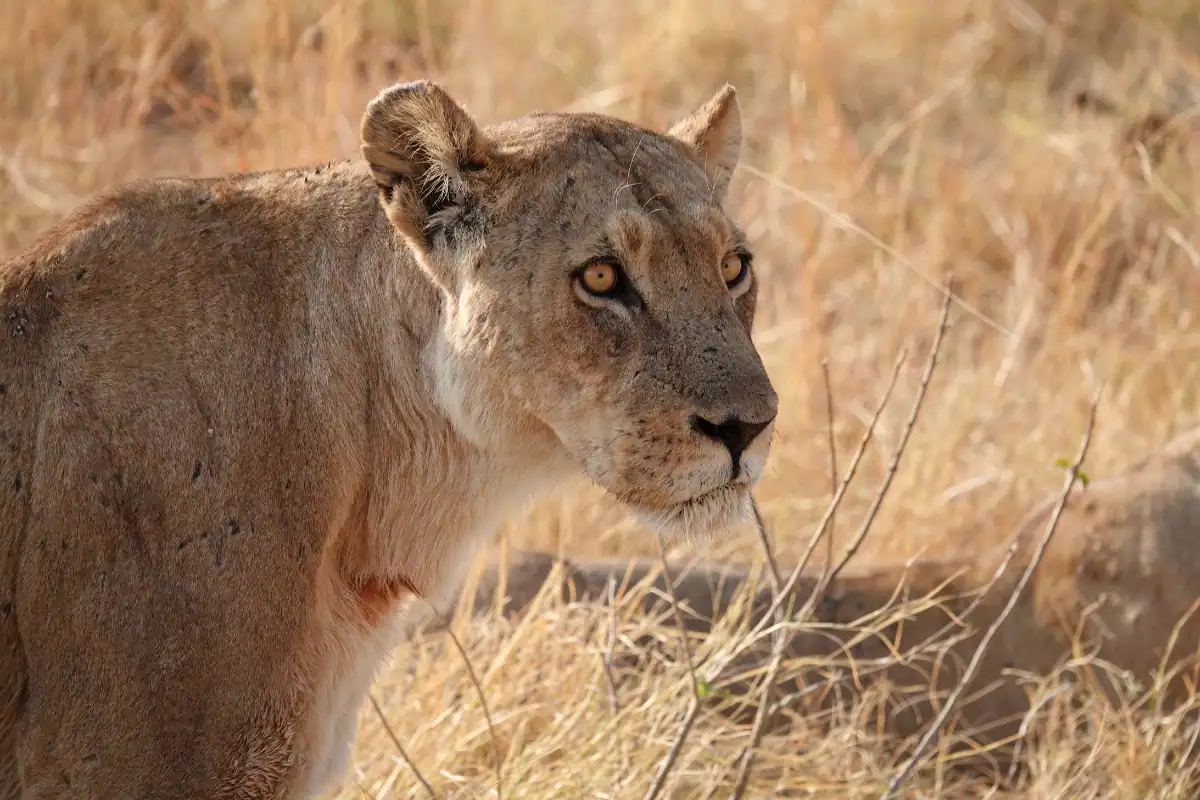
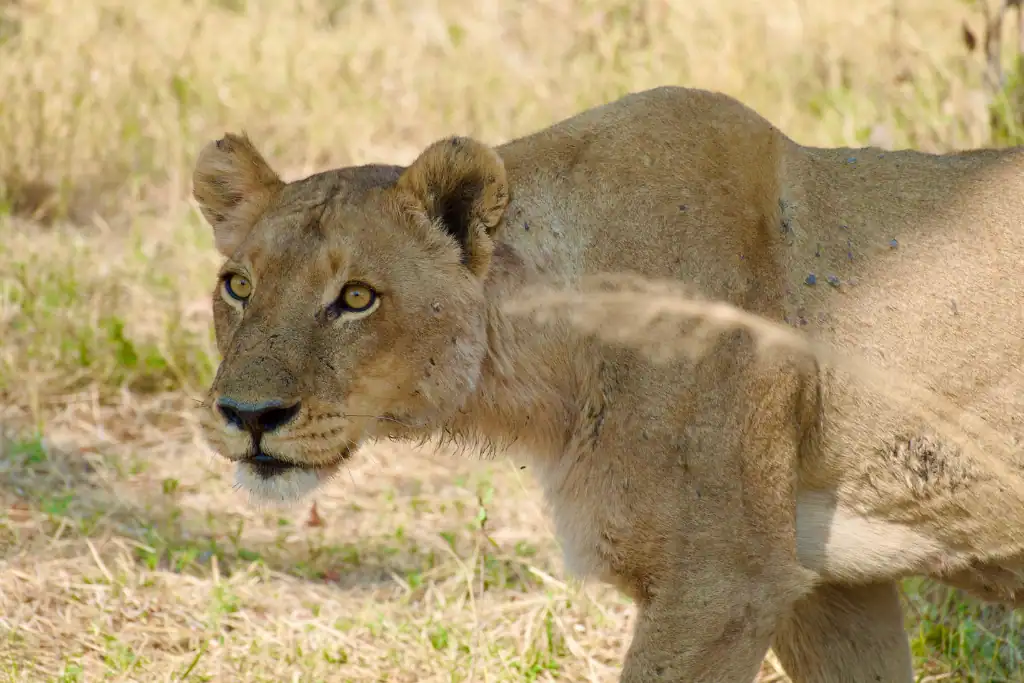
For example, if you look at the picture above, our guide told us to stay still because the lion seemed so intense and alert that it was worrying. She was looking directly at our vehicle.
We sat there still, and eventually she lost interest. That was scary! This scenario was kind of obvious, which is not always the case.
3. Do not run
If you are on a walking safari and unexpectedly come face-to-face with a lion, do not run. I have never been on a walking safari and I don’t intend to, because, personally I just feel nervous about being on foot in an unfenced wilderness with large wildlife.
On my last safari, we were on the same path tracking lions in the Okavango Delta, and my guide told me that was the same route they used on walking safaris.
That area was where I saw lions, leopards, elephants, and buffalo—dangerous animals.
That being said, walking safaris are a standard guided activity in Botswana run by armed professional guides.
4. Stay alert at all times
Even at your lodge, because these camps and lodges are unfenced and lions roam free. During my orientation at Sable Alley, that was part of the orientation because it occasionally happens where lions roam across the camp. The message was the same: ‘do not run’.
5. Maintain a respectful distance.
This is taken seriously in Botswana. You can only have a maximum of three vehicles around lions or other animals at a time. Moreover, overcrowding the animals can antagonise them, especially elephants.